
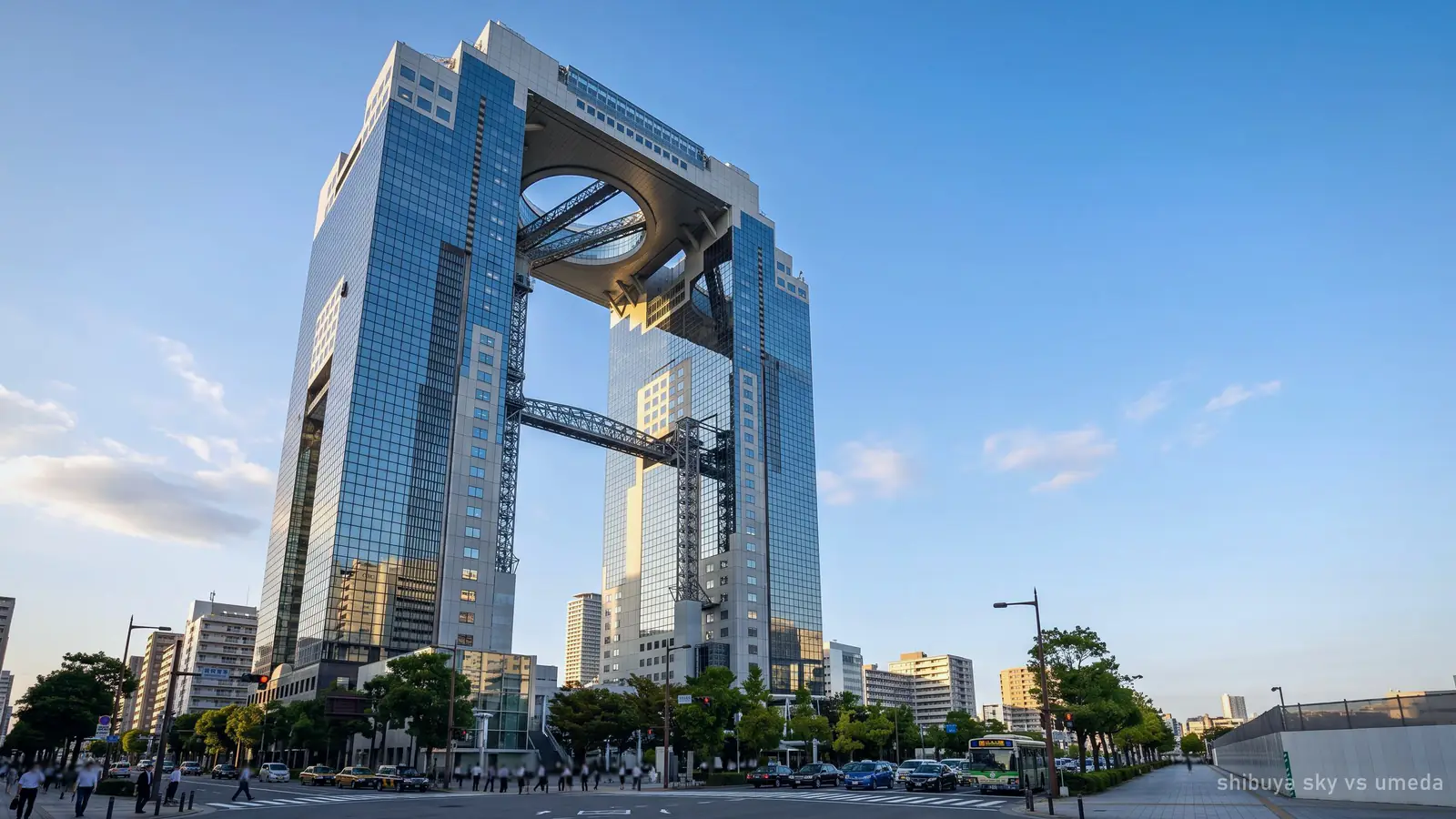
These two come up together because they are Japan's best-known open-air observation decks, and because the Umeda Sky Building's Kuchu Teien (Floating Garden) Observatory did the idea first, in 1993. Osaka's official tourism board puts that deck at 173 m (osaka-info.jp) against Shibuya Sky's 229.7 m (Wikidata P2048), and the operator sells it at 2,000 yen for adults, open 9:30 to 22:30 with last admission at 22:00 (skybldg.co.jp, the official site). Its own description of the top floor — "A 360-degree open air rooftop observation floor for changing views at any time" — could as easily be describing Shibuya Sky. The comparison is real but the practical answer is usually geography: one is in Tokyo and the other is 400 kilometres away in Osaka.
| Criterion | Shibuya Sky | Umeda Sky Building |
|---|---|---|
| City | Tokyo | Osaka |
| Height | 229.7 m rooftop | 173 m Kuchu Teien Observatory |
| Adult price | 2,700 yen (~$17) before 15:00, 3,400 (~$22) after | 2,000 yen |
| Opened | 2019 | 1993 |
| Open air | Yes, full rooftop | Yes, the Floating Garden Observatory |
| The signature feature | Looking down on Shibuya Crossing | The escalator across the open gap between the towers |
| Booking | Timed slot 14 days ahead | Generally straightforward |
Two different kinds of open air
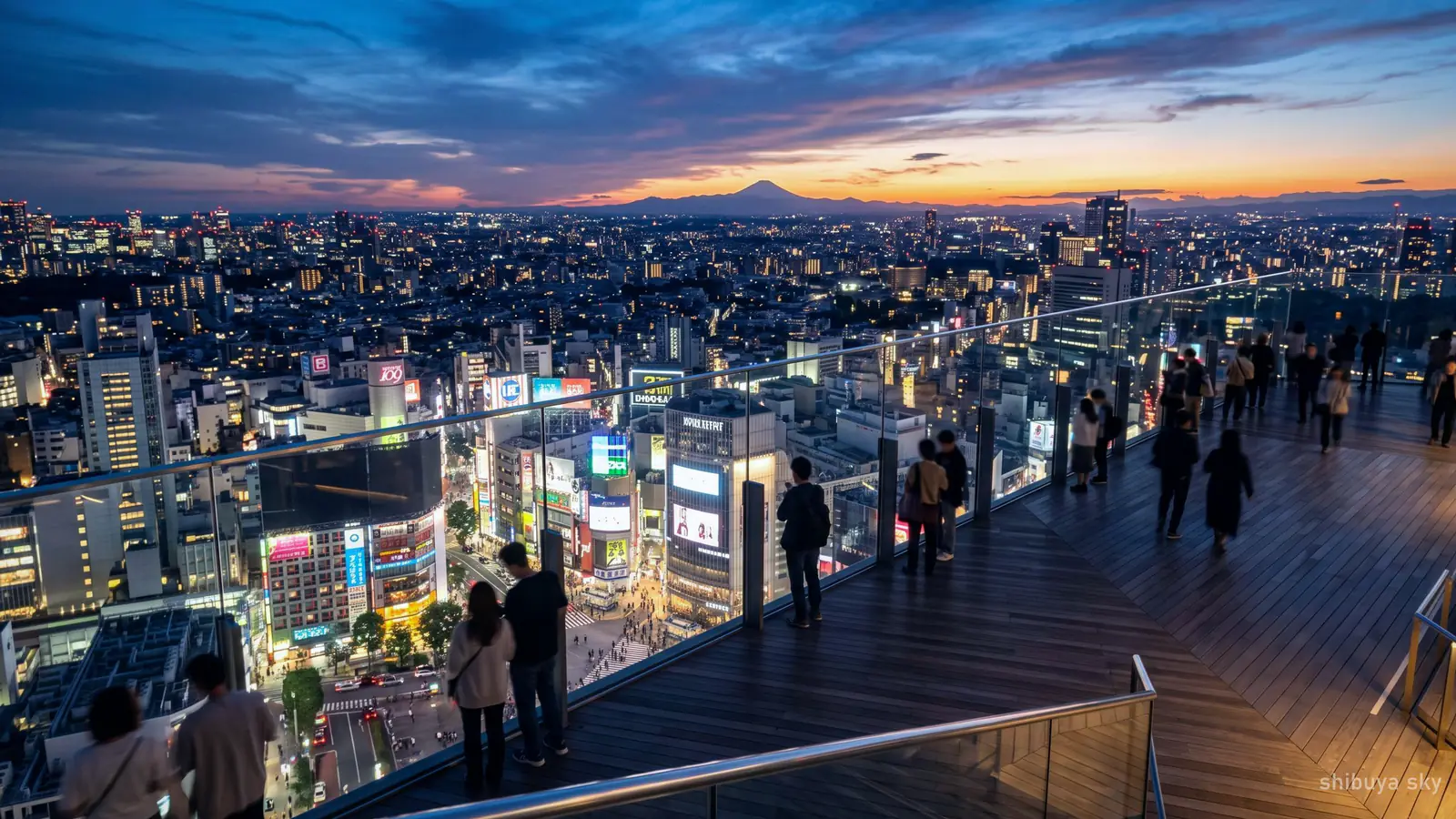
Umeda's observatory is a ring bridging two towers, with a famous escalator crossing the open void between them at high level. Shibuya Sky is a flat roof you walk out onto, with the view unbroken in every direction. Umeda is the more dramatic piece of architecture; Shibuya Sky is the better platform for looking at a city.
What is below you
This is where Shibuya Sky separates itself. Directly beneath the roof is Shibuya Crossing and the densest low-rise sprawl in Tokyo, and the view runs to Tokyo Tower, Skytree and, on clean winter days, Mount Fuji. Umeda looks over Osaka, a flatter and less relentless cityscape, with the Yodo river and the bay.
Ease of visiting
Umeda is generally easier: no fourteen-day midnight release, no half-hour slot to hit. Shibuya Sky's booking is the hardest part of visiting it. If ease matters more than the view, that is a genuine point in Umeda's favour.
Getting to each one
This is where the practical gap is widest. Shibuya Sky is built directly on top of Shibuya Station, which puts it 34 metres from the station in a straight line — you are inside the building before you have really left the concourse, and the only navigation problem is finding the level 14 entrance rather than drifting out through the Hachiko exit. The Umeda Sky Building sits north of Osaka Station across a stretch of road and rail, and the walk is longer and less obvious than the map suggests. Neither is difficult; one is trivial.
The escalator, and why Umeda is the better building
The Umeda Sky Building's signature is the escalator that crosses the open void between its two towers near the top, glazed and suspended with nothing below it. It is a genuinely unusual piece of engineering and it is the thing people photograph. Shibuya Sky has its own theatrical ascent through SKY GATE, but that is interior drama in a conventional tower. As architecture, Umeda wins clearly; as a place to stand and look at a city, it does not.
Weather, and which is the safer booking
Both are open-air, so both carry the risk that the roof is shut when you arrive. Shibuya Sky's rooftop closes for wind, lightning, rain and extreme heat, and the ticket is not refunded because the indoor gallery stays open. The practical difference is the booking: Shibuya Sky ties you to a half-hour slot chosen fourteen days in advance, so a bad-weather day cannot easily be swapped, while Umeda's more relaxed admission lets you simply go on a better day. If your trip is short and the forecast is unsettled, that flexibility is worth more than any difference in the view.
 Ready to compare prices? TOKYO SKYTREE Admission Ticket, from $14 See times
4.7(46,498 · Klook)
Check prices & dates
Book your tickets in advance: popular time slots sell out.
Book Shibuya Sky tickets
From$17per person
Check availability- Instant confirmation
- Official price, ¥2,700+
- 3M+ booked on Klook
Price checked Oct 13, 2026
Frequently asked questions
Which is better, Shibuya Sky or the Umeda Sky Building?
Shibuya Sky has the denser, more dramatic view; the Umeda Sky Building is the more interesting piece of architecture and is easier to visit. In practice, go to whichever city you are in.
Are they both open-air?
Yes. Umeda's Floating Garden Observatory opened in 1993 and predates Shibuya Sky by twenty-six years.
Is one worth travelling between cities for?
No. Both are worth doing while you are in their city; neither justifies a 400-kilometre trip on its own.
Which is easier to get to?
Shibuya Sky, by a wide margin. It is built on top of Shibuya Station. The Umeda Sky Building is a longer and less obvious walk from Osaka Station.
Is either better in bad weather?
Neither: both are open-air. Umeda is the safer booking because you are not locked to a half-hour slot chosen two weeks ahead.
Sources