
informational 5 min read
Seeing Shibuya Crossing From Above
Updated September 21, 2026
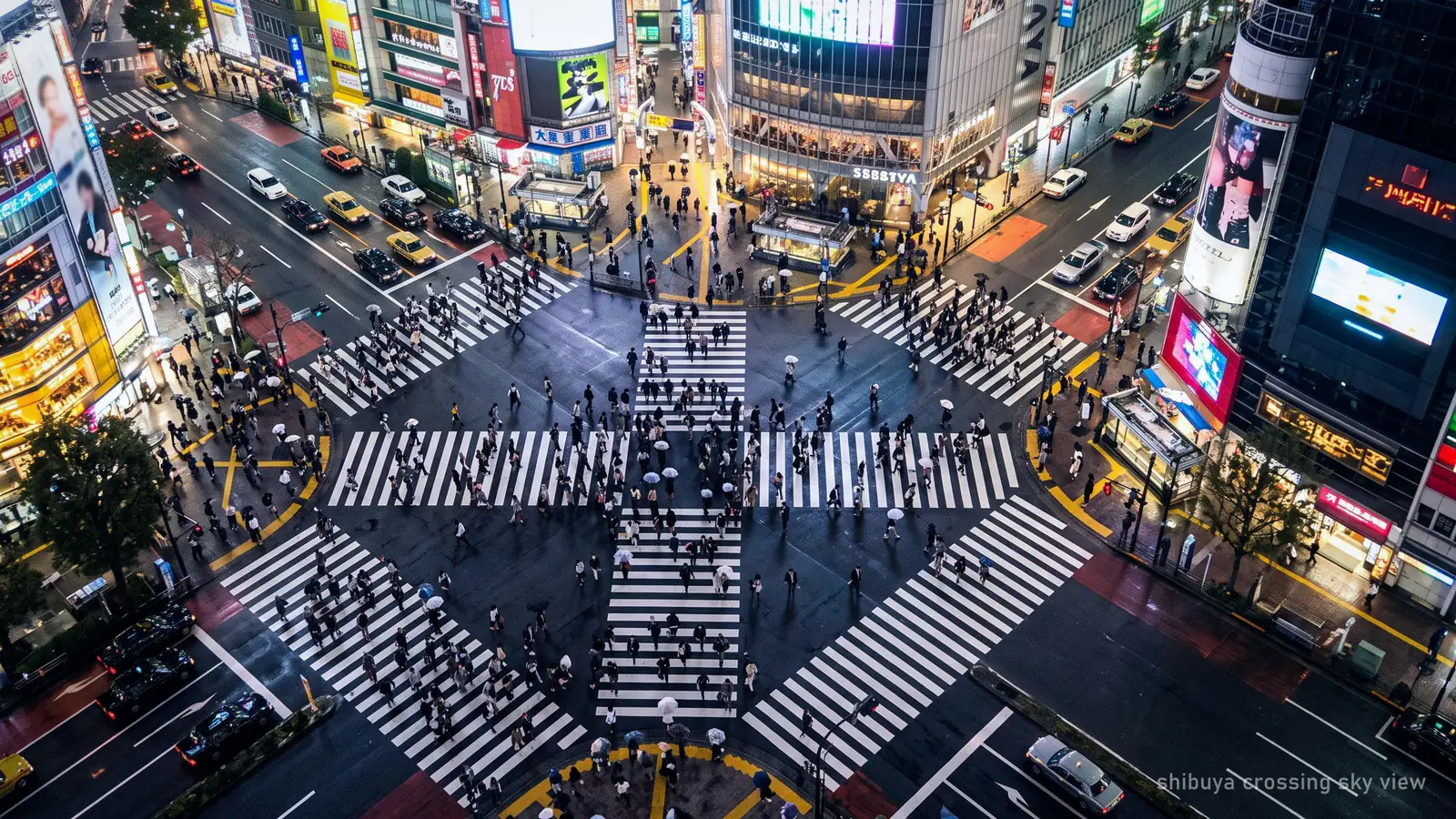
Yes, and it is the main reason to choose this deck over the taller ones. Shibuya Sky is built on top of Shibuya Station, and the southern corners of the rooftop look almost straight down onto the scramble crossing. Tokyo Skytree is several kilometres east and Tokyo Tower is in Minato; neither can show you this. It is specific to this building.
What it looks like from 229 metres
From street level the crossing is disorder: a few thousand people an hour moving through each other in every direction, and no way to see the shape of it. From directly above it resolves into a system running on a clock.
The signal cycle does the work. Traffic runs, the crossing is empty asphalt marked with white bars. Then every light turns and several hundred people step off all four corners at once and walk through one another, diagonals included. Thirty seconds later it is empty again. Watching that cycle repeat from above is the thing people actually remember about Shibuya Sky, more than the skyline.
Wait for a full cycle before you take a photograph. The first thing you see will probably be half-empty.
Where to stand
The southern edge of the rooftop SKY STAGE. There is usually a queue for the best corner position, and it moves, so join it rather than trying to shoot over people from further back. Bear in mind the photography rules: bags go into lockers on level 46 before you come out, and tripods and selfie sticks are not allowed on the observation space at all.
Day, sunset or after dark
After dark is the strongest version. The surrounding buildings are covered in screens and signage, so the crossing is lit from every side and the moving crowd reads as light rather than as people. Daylight gives you the clearer geometry and the surrounding sprawl; sunset gives you both in sequence if you time the slot properly.
Last admission is 21:20, and those late slots are much easier to book than sunset while costing the same. For the crossing specifically, that is a good trade.
Seeing it without paying
The crossing itself is free and always has been, and a lot of what people want from Shibuya Sky is the crossing. You can walk it as many times as you like. The station’s elevated walkways and the upper floors of the buildings around the junction give perfectly serviceable views of it in motion at no cost, and the free viewpoints page covers the better ones.
What none of them give you is the straight-down angle from 229 metres in open air. That is what the ticket buys.
How many people actually cross
The figure quoted for Shibuya Crossing is usually somewhere between one and three thousand people per signal change at the busiest times, and around half a million a day across the junction. Treat the exact numbers with caution — they circulate widely without a clear source, and the operator does not publish a count. What is not in doubt is what you can see for yourself from the roof: a full stop, then a diagonal flood from all sides, then empty asphalt, on a cycle of roughly two minutes.
The scramble format itself is the reason it works visually. Every light in the junction turns red together and pedestrians get the whole intersection, diagonals included, rather than being funnelled along the edges. From street level you only experience your own diagonal. From above you see all of them at once, which is the entire appeal.
Where else to see it from
There are three other vantage points, and they are worth knowing because the rooftop is neither the cheapest nor always available.
The Hachiko exit concourse and the elevated walkways around the station give you a near-ground view along the crossing, which is the angle most film footage uses. It costs nothing.
The upper floors of the buildings fronting the junction look down on it obliquely from perhaps ten storeys, close enough to pick out individuals. Several are cafés, so the price of entry is a drink. The free views page covers these.
And then the rooftop, 229 metres up and almost vertically above it. The trade is scale against intimacy: from Shibuya Sky the people are specks and the pattern is everything, while from ten floors up you see faces and umbrellas but lose the shape.
When the crossing is at its busiest
Weekday evenings from about 18:00, and Friday and Saturday nights, are the densest. Rain changes the picture completely and mostly for the better: umbrellas turn the crowd into a moving field of circles, which from directly above is the most distinctive version of the scene. That is worth remembering given the rooftop closes in bad weather — light rain without wind may still leave the roof open, and it is the condition that makes the best photograph.
Check prices & dates
Book your tickets in advance: popular time slots sell out.
Compare Shibuya Sky tickets