
For a first visit to Tokyo, yes — with two conditions. It is worth it if you get a slot near sunset and if the weather lets the rooftop open. On a grey afternoon, from a slot you settled for, it is an expensive look at a large grey city, and Tokyo Tower's Main Deck at 1,500 yen (japan-guide.com) or the free Sky Lobby on Hikarie's 11th floor would have done.
The case for it is specific: an open rooftop at 229 metres with no glass in the way, directly above the world's busiest pedestrian crossing. The case against is equally specific: the booking is a chore, the roof shuts in bad weather without a refund, and at 2,700 to 3,400 yen (Go Tokyo, the official Tokyo travel guide, updated 23 April 2026) it costs more than Tokyo Tower's main deck at 1,500 yen and sits just under Skytree's 2,400–2,600 yen first deck (japan-guide.com).
What you are actually paying for
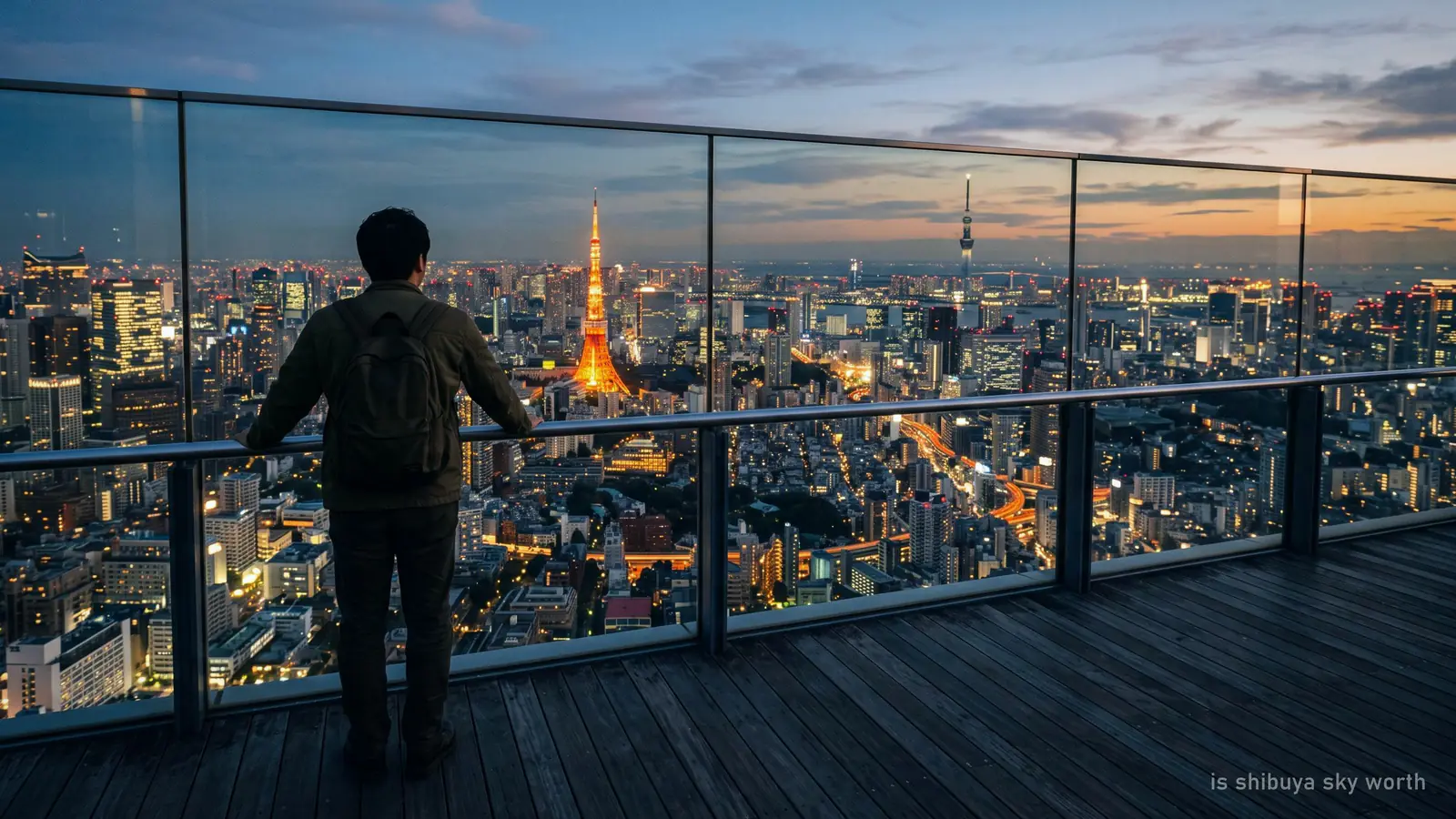
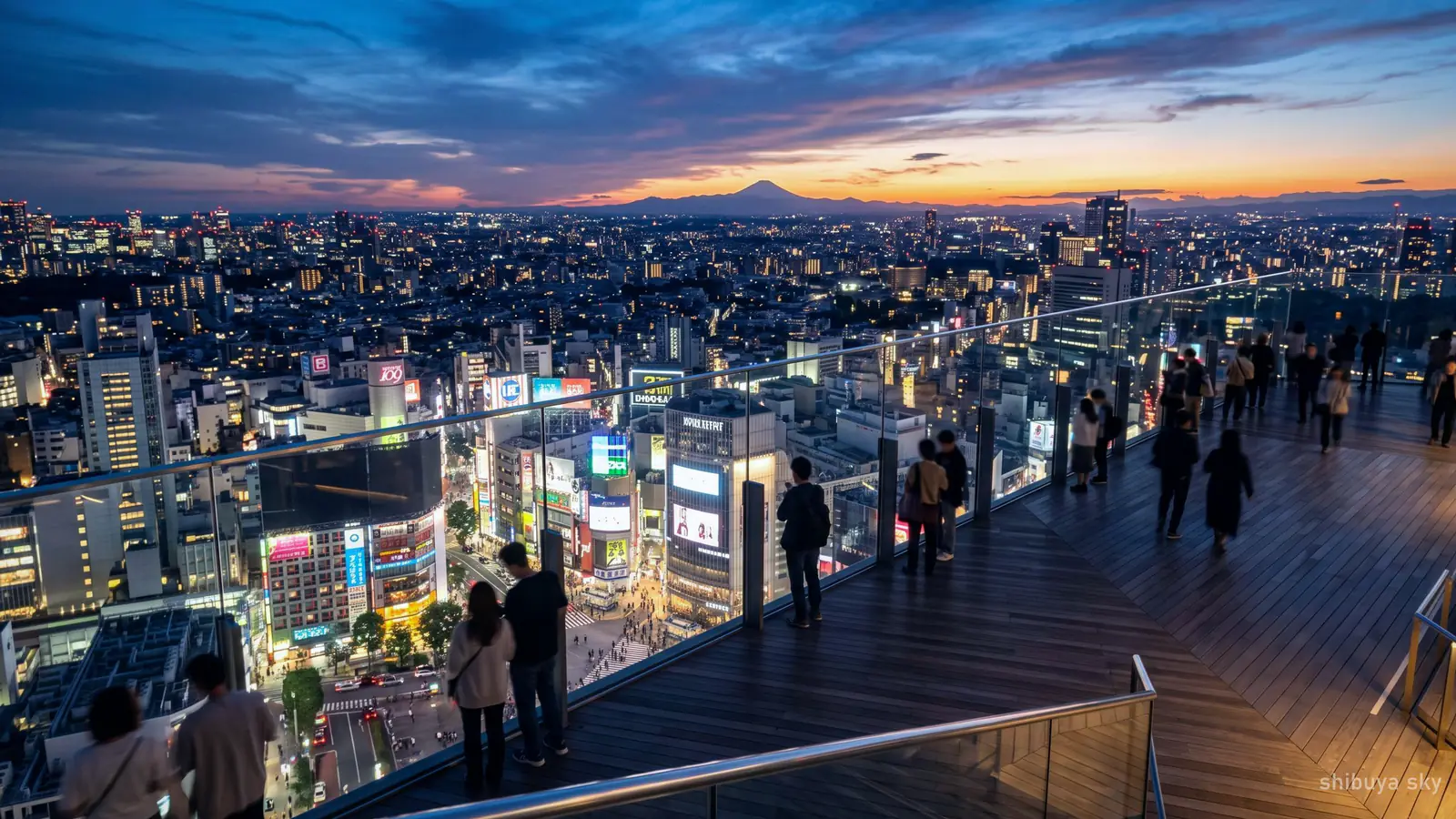
Open air. Most observation decks in Tokyo put you behind glass, and the photographs show it. Shibuya Sky's SKY STAGE is a rooftop, so the view has nothing between you and the city, and the edge corners look straight down onto Shibuya Crossing — by Guinness World Records' reckoning the world's busiest pedestrian crossing, with "an estimated one million pedestrians each day" (verified 2014). Japan Guide describes the deck as "a spectacular open-air deck which divides visitors from the unobstructed views over the city with nothing but a layer of glass at the very edge of the building". On a clear day the skyline includes Tokyo Tower and Tokyo Skytree, and Mount Fuji is visible when the air is clean — far more often in winter: the Fuji City observation record shows the whole mountain on 52.6% of February mornings against 12.4% of June ones across 1991 to 2025 (fujiside.com, from Fuji City records, taken much closer to the mountain than Tokyo).
What people complain about
Three things, consistently. The booking: tickets appear fourteen days out at midnight Japan time and the sunset slots go in minutes (stated independently by Klook, Trip.com, Tripadvisor and KKday, all checked 21 September 2026; the operator publishes no English statement of it). The weather: the rooftop closes for wind, lightning and extreme heat, and neither the ticket nor a tour built around it is refunded when it does. And the lockers: bags and loose items must be stored before you go out, and tripods and selfie sticks are not allowed up at all, which catches out people who came to photograph it.
The cloudy-day question
If the forecast is heavy cloud, consider moving the booking rather than going. The indoor SKY GALLERY on level 46 stays open when the roof closes, so you will see something, but the thing you paid for is the open rooftop. Low cloud does not always mean a bad visit — a city under cloud at dusk can be better than a hazy clear afternoon — but rain with wind usually means the roof is shut.
Who should skip it
Anyone who has one evening and no booked slot, because the scramble is not worth the stress. Anyone travelling with a tight budget, since the free viewpoints around Shibuya cost nothing and give you the district if not the height. And anyone who has already booked Tokyo Skytree: both are observation decks, and doing both on a short trip is a lot of money for a repeated experience, unless the open-air difference is exactly the point for you.
 Ready to compare prices? TOKYO SKYTREE Admission Ticket, from $14 See times
4.7(46,498 · Klook)
Check prices & dates
Book your tickets in advance: popular time slots sell out.
Book Shibuya Sky tickets
From$17per person
Check availability- Instant confirmation
- Official price, ¥2,700+
- 3M+ booked on Klook
Price checked Oct 13, 2026
Frequently asked questions
Is Shibuya Sky worth it on a cloudy day?
Less so. The rooftop closes in bad weather and is not refunded, and the indoor gallery is not what you paid for. Cloud alone can still be atmospheric at dusk; rain with wind usually is not.
How much time do you need at Shibuya Sky?
About ninety minutes door to door, including the ascent through SKY GATE and the compulsory locker stop on level 46.
Is it better than Tokyo Skytree?
It is lower and cheaper, and it is open to the air. Skytree is taller, enclosed and unaffected by weather. The comparison page sets them side by side.
Sources