
informational 6 min read
Shibuya Sky at Night: The View After Dark, and the Last Slots
Updated September 21, 2026
Shibuya Sky’s last admission is 21:20 and the deck closes at 22:30, so there is a long window after dark that most visitors never consider because they are all trying to book sunset. The night slots are the easiest ones to get, cost the same as any other post-15:00 entry, and give you the version of Tokyo that actually looks like the photographs people come for.
Night or day: the honest answer
Different things, and the question is really about what you want to look at.
By day you see structure. The scale of the sprawl is legible, you can pick out Tokyo Tower and Skytree, and on a clear winter morning Mount Fuji is on the horizon. Daytime also gets you the cheaper 2,700-yen band if you enter before 15:00.
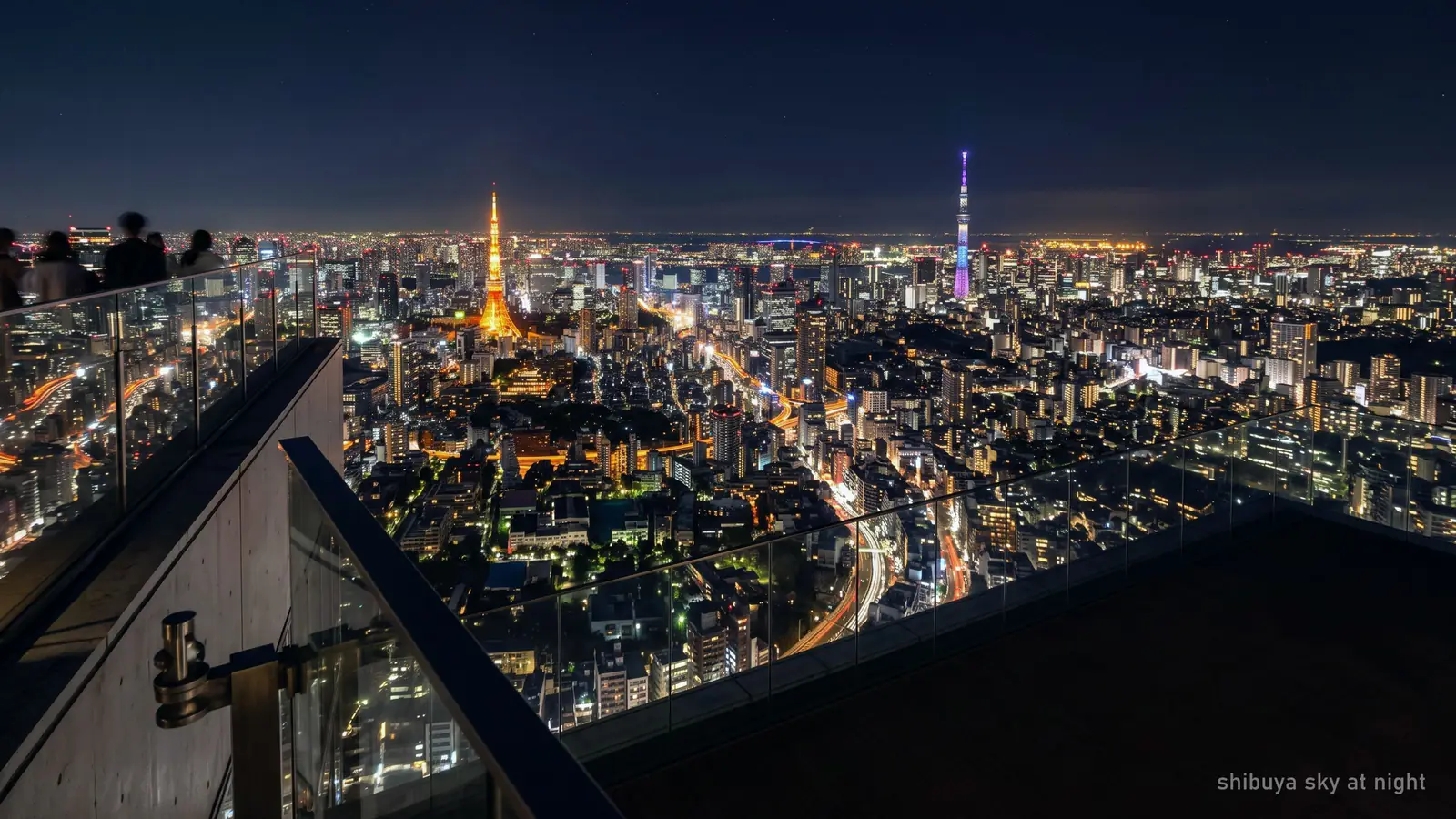
After dark you see activity. The crossing turns into a pulse of light and movement, the sprawl becomes an unbroken field of illumination to the horizon, and the scale reads as endless rather than merely large. What you lose is the skyline and any chance of Fuji.
If you can only do one and you want the most dramatic version, go at night or at the tail of sunset. If you want to understand the geography of Tokyo, go in daylight.
The crossing from 229 metres up
This is the reason the night visit works. Shibuya Crossing is directly below the rooftop’s southern corners, and after dark it is lit by the screens and signage on every surrounding building. The pedestrian scrambles come in waves on the signal cycle — a full stop, then several hundred people crossing in every direction at once, then empty asphalt. From street level it is chaos; from directly above it is clearly a system, and that shift in perception is the thing people remember.
Why the late slots are easier
Tickets are released fourteen days ahead at midnight Japan time, and demand concentrates on the few half-hour windows around sunset. The slots from about 20:00 onwards are frequently still available when the sunset ones have been gone for a fortnight. They cost the same 3,400 yen as any other post-15:00 entry, so you are not paying a premium for the convenience.
If your dates are fixed and the sunset slot has gone, a late slot is a far better outcome than abandoning the visit. The ticket release page covers the other fallbacks.
Shooting at night
The photography rules matter more after dark, because the conditions are harder and the equipment you would normally reach for is not allowed. Tripods and selfie sticks are prohibited on the observation space. Everything loose goes into a locker on level 46 first. You are shooting handheld at night, in wind, at 229 metres, through no glass.
That last part is the compensation: no glass means no reflections, which is the thing that ruins night photographs from enclosed decks like Tokyo Tower and Skytree.
What closes, and when
The open-air SKY STAGE shuts in wind, lightning, rain and extreme heat, and the ticket is not refunded when it does. The indoor SKY GALLERY on level 46 stays open. An evening slot is actually the safer bet in high summer, when afternoon heat is a genuine closure risk — the bad weather page has the detail.
Check prices & dates
Book your tickets in advance: popular time slots sell out.
Compare Shibuya Sky tickets