
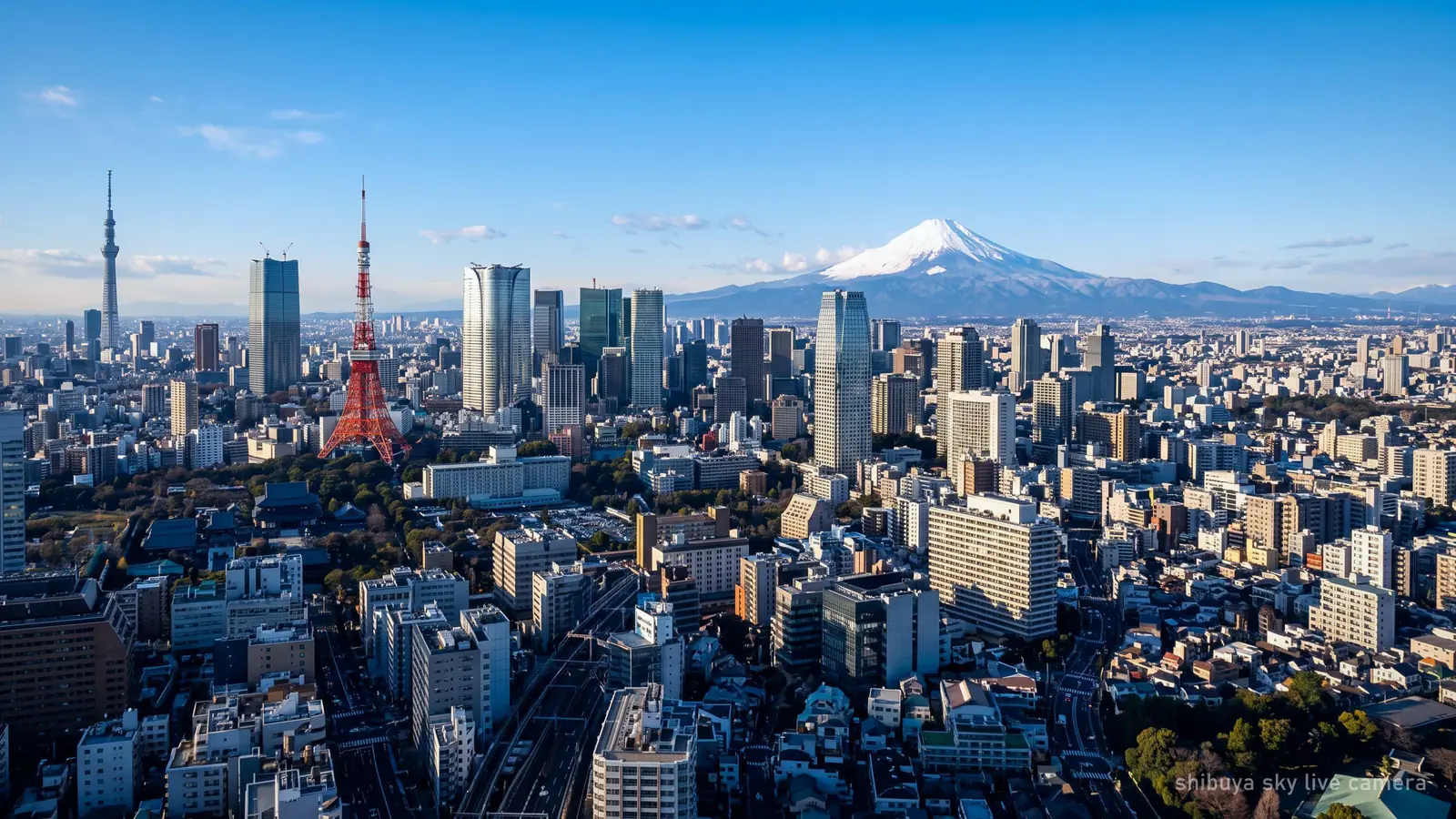
Can you see Mount Fuji from Shibuya Sky?
Quick answer
Yes, on a clear day. Mount Fuji sits about 100 kilometres south-west of Shibuya and is visible from the rooftop when the air is clean enough, which is far more often in the cold months than in summer. Winter mornings and the hour after a front clears are the best odds; humid summer afternoons are the worst.
Nothing about the ticket guarantees it, and no slot is a Fuji slot. Treat a Fuji sighting as a bonus on top of the city view rather than the reason to book, because the chance on any given day is genuinely uncertain.
Why winter is so much better
Summer in Tokyo is humid, and humidity plus haze cuts long-distance visibility to a fraction of what it is in January. Tokyo's coldest months are also its driest: the climate normals for the city put January rainfall at 62 mm across about five wet days, against a far wetter early summer. Dry, cold, post-frontal air is what makes a 100-kilometre sightline possible, and that combination belongs to winter.
Time of day
Early is better than late for Fuji specifically, which pulls against the sunset slots everyone wants. Haze builds through the day, so the 10:00 opening gives the cleanest air. The exception is the half hour around sunset in winter, when Fuji can appear in silhouette against the colour even if it was invisible at midday. If Fuji is the goal rather than the city lights, book the first slot of the day in a winter month.
How to check before you go
There is no official live camera for the deck itself, but Tokyo's general visibility on the day is a reasonable proxy, and the direction that matters is south-west. If you can see the far skyline clearly from street level, the chances from 229 metres are decent. If the near towers are already softened by haze, Fuji will not be there.
What you will see regardless
The reliable view is the city itself: the crossing directly below, and Tokyo Tower and Tokyo Skytree on the skyline in clear conditions. The daylight table on the sunset page gives the exact times the light changes each month, which is a far more dependable thing to plan around than a mountain 100 kilometres away.
The months when the air is actually clear
Tokyo's climate normals make the pattern plain. January and February average 62 and 60 mm of rain across about five wet days each; September averages 201 mm across thirteen. December is 63 mm over six days. The cold months are not just colder, they are drier and far less hazy, and dry cold air is what makes a 100-kilometre sightline possible. If Mount Fuji matters to you, visit between December and February and accept that you will be standing on an open roof at 229 metres with a daytime high of 8 to 11 degrees.
What the rest of the year gives you
June to September is the wrong half of the calendar for distance. July and August average 159 and 135 mm of rain with thirteen wet days each and daytime highs approaching 30 degrees, and humidity that high softens everything past a few kilometres. September is the wettest month of all at 201 mm. Those months can still produce a clear evening after a front passes, but the odds are poor and the rooftop itself may close for heat. March through May and October through November sit in between: April at 123 mm and October at 140 mm are workable, and the light in late autumn is often better than the raw rainfall suggests.
What else is on the horizon
Fuji is the prize but not the only landmark worth finding. Tokyo Tower sits to the south-east of Shibuya and is easy to pick out, lit orange after dark. Tokyo Skytree is further east and taller than anything around it, so it reads clearly even in mediocre visibility. The Shinjuku cluster of high-rises is close by to the north. On a genuinely clear winter day you are looking across the whole Kanto plain, and the limiting factor is the curve of the earth rather than the air.
Frequently asked questions
Is Mount Fuji visible from Shibuya Sky?
On clear days, yes. It is about 100 km south-west. Visibility is much better in winter than in humid summer conditions.
What time of day is best for seeing Fuji?
Early. Haze builds through the day, so the first slots after the 10:00 opening give the cleanest air, with winter sunset as a second chance.
Is there a live camera for Shibuya Sky?
Not an official one for the deck. General visibility toward the south-west from street level is a workable proxy.
Which months are best for Mount Fuji?
December through February. Tokyo averages 62, 60 and 63 mm of rain in January, February and December, against 201 mm in September, and the cold dry air carries far better.
Can I see Tokyo Skytree and Tokyo Tower too?
Yes, both, in ordinary conditions. They are much closer than Fuji and easier to pick out, and both are lit after dark.
Sources